Plan your office coffee machine installation before delivery day. Counter space is only the start: check whether the proposed setup leaves room to open, refill and clean the machine, and where any fridge or accessories will go.
Send the supplier a few photographs and measurements of your pantry before agreeing a date. For an existing office in Chandigarh, Mohali or Panchkula, a site check can settle the practical details that a product photograph cannot show.
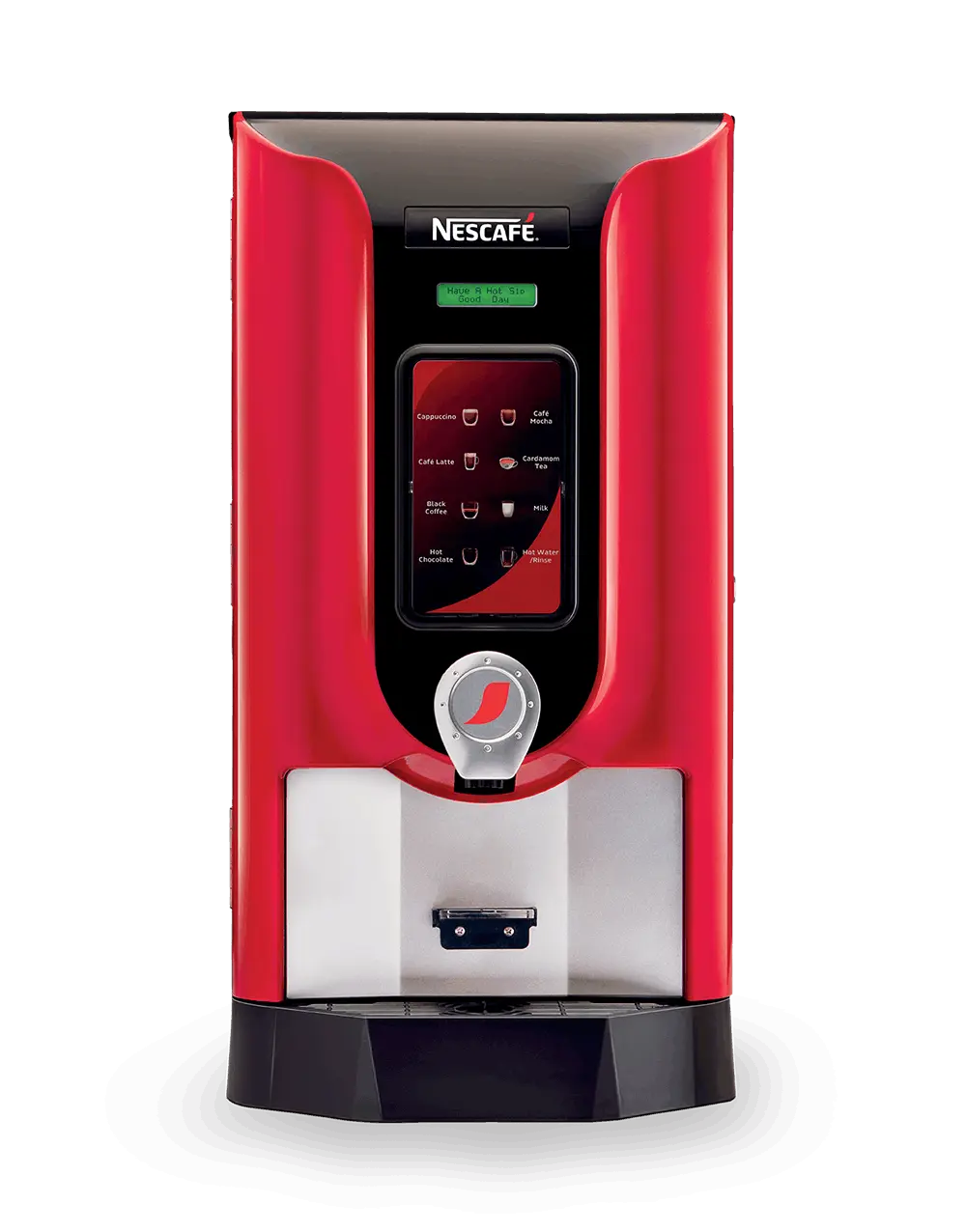
NESCAFÉ Solution 2.0, shown as a soluble-system reference from our existing website. Installation requirements must be confirmed for the exact offered model.
Office coffee machine installation: get the model sheet
Ask for the current technical documentation for the model and accessories in the quotation. Do not use a specification from a similar-looking product, an older brochure or a different market without confirmation. Different configurations can require different arrangements.
Record the model identifier and document date with your purchase or rental paperwork. Ask the supplier to resolve any disagreement between the quotation, brochure and proposed equipment before delivery. This guide provides a checklist, not universal electrical or plumbing instructions.
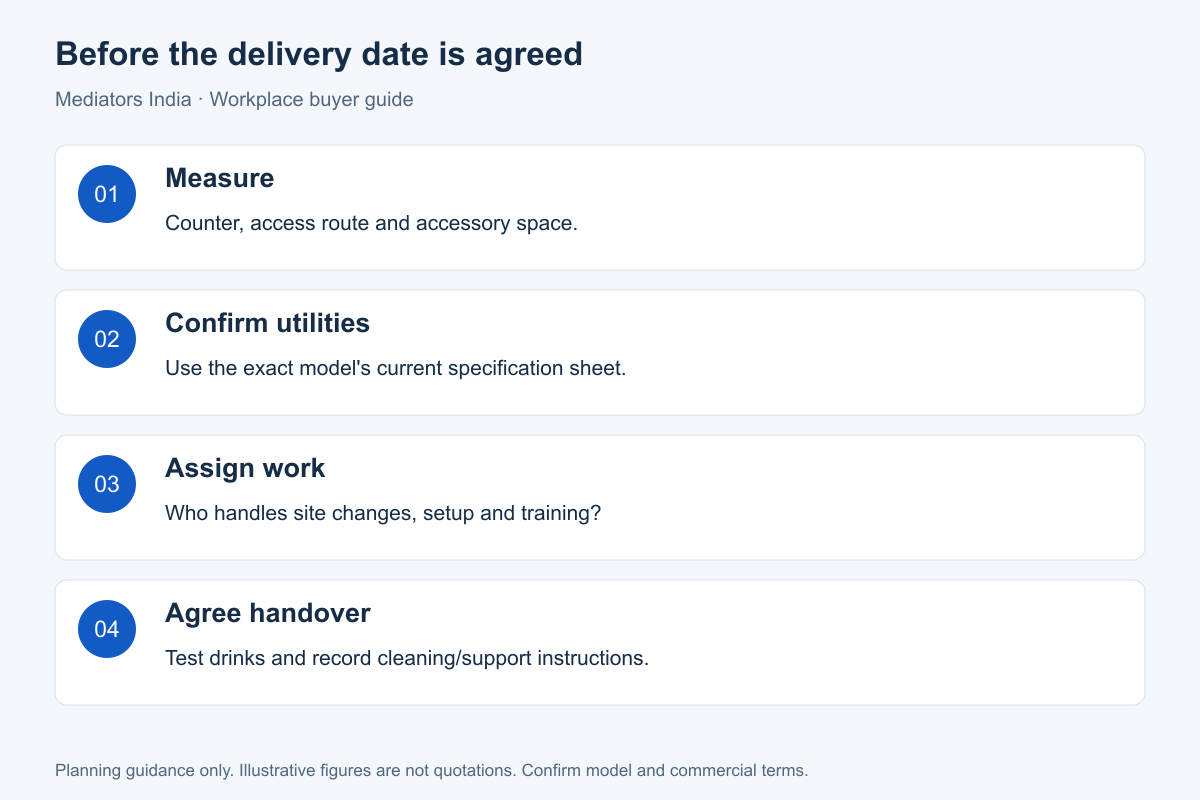
Original planning graphic. Any figures shown are illustrative; confirm commercial and technical details.
Measure more than the machine
Measure the counter width, depth and usable height. Include any accessory, refrigerator, water container or supply storage that forms part of your proposal. Ask for the required clearances and how staff will reach filling and cleaning points.
Check the delivery route too: doors, lifts, stairs and the final approach to the counter. Tell the supplier about access restrictions and building rules. A machine that fits its destination may still require a practical delivery plan.
| Area | Confirm before delivery |
|---|---|
| Counter | Suitable dimensions, support and required clearances |
| Electricity | Requirements from the exact specification sheet |
| Water | Supply arrangement and any treatment requirements |
| Waste and cleaning | Required collection, emptying and cleaning arrangements |
| Accessories | Space, connections and access included in the plan |
| Delivery route | Building access and agreed handling responsibilities |
Agree who prepares the site
Have the supplier explain any required electrical, plumbing, filtration or other work. Ask who arranges and pays for it, and whether it must be completed before the equipment arrives. Obtain appropriate professional help for site work rather than improvising an installation.
Confirm whether delivery and commissioning are included in the quote or charged separately. Clarify what happens if the site is not ready on the agreed day. This avoids treating a provisional delivery date as a guaranteed fully operating start date.
Plan for the person operating it
Identify who refills ingredients, performs routine cleaning and calls for support. Ask what training and instructions are provided. If more than one person covers the pantry, make sure each understands the tasks relevant to the proposed setup.
Discuss where supplies will be stored and how the team will check stock. Keep manufacturer handling and cleaning instructions available at the pantry. Do not assume a cleaning feature replaces every manual task or that one model's routine applies to another.
Budget for the whole handover
Request a written breakdown for delivery, installation, any accessories, site changes, training and recurring service. Ask for deposits, applicable taxes and excluded items to be identified. No installation price is assumed in this checklist.
Keep setup expenditure separate from ingredients when forecasting the first month. A recurring cost-per-cup estimate may leave out one-time charges. For the ongoing calculation, see the rental versus purchase comparison, whose figures are explicitly illustrative.
Write down what is ready, and what is missing
Use a single record rather than sending isolated photographs. Write down counter width, usable depth and height to the shelf above it. Mark the power and water locations on a photograph. Identify the full list of accessories, and ask the installer to mark the space needed to refill and service each part.
For example, the current Solution 2.0 specification lists a machine and refrigerator separately. That is a concrete reason not to reserve space for the main machine alone. Treat the supplier's signed site plan for the offered configuration as the installation reference.
Water quality is a separate check from simply having a water connection. BUNN's commercial guidance distinguishes drinkable water from water suited to beverage preparation and equipment. Ask the installer what test or treatment the selected machine requires; do not buy a generic filter on the assumption that every filter solves the same issue.
| Handover test | Evidence to keep |
|---|---|
| Equipment and accessory match | Model identifiers against the quotation |
| Agreed drink | Cup size and recipe demonstrated |
| Routine operation | Trained operator and instructions provided |
| Closing routine | Demonstration of cleaning and waste handling |
| Support | Reporting contact and agreed service scope |
Record outstanding items and who will close them before treating the setup as fully handed over.
Frequently asked questions
Can I install it next to a normal office socket?
The exact electrical requirements must be checked against the offered configuration and site. Do not infer suitability from the plug's appearance or a general machine-category description.
Is bottled or filtered water automatically suitable?
No. Different water sources and treatments have different characteristics. Use the selected machine's guidance and the installer's assessment rather than assuming any filtered water is ideal.
Does it need plumbing?
That depends on the model and supply arrangement. Confirm filling, water treatment and any waste or drainage requirements before approving site work.
What if the counter fits but refilling is awkward?
Then the installation plan is incomplete. Access for refilling, cleaning and service belongs in the space assessment, alongside the equipment footprint.
What should pantry staff learn at handover?
The approved refill, cleaning, opening/closing and fault-reporting routines. Technical repairs and unapproved adjustments are not routine operator tasks.
Check the setup before signing off
At handover, verify that the delivered configuration matches the proposal. Ask for the selected drinks and serving sizes to be demonstrated. Record support contact details, the agreed service process and any outstanding work.
Make a short handover record covering equipment, accessories, instructions, training and responsibilities. If performance during a busy break was important to your choice, confirm the operating assumptions with the supplier.
For local planning, explore office coffee machine arrangements and share your pantry photographs, measurements and expected drinks. Mediators India can discuss the available equipment and terms; site requirements must be confirmed for the exact proposed model.