The first tea order is easy to overdo. A large box looks reassuring until you discover the team prefers a different flavour—or drinks far less tea on work-from-home days.
For NESTEA Masala Gold, start with a tasting and a current pack check, then work out the order. The aim is enough tea for the pantry, without treating a supplier's pack yield as a guarantee of your office's actual consumption.

Product reference from the existing Mediators India website; confirm the current offered pack or model and configuration. This is not a customer installation.
Check the product, not just the name
Nestlé Professional's Masala Gold page lists a 1 kg pack, sugar and milk solids among the ingredients, and milk as an allergen. It gives a yield of 71 cups with a stated 150 ml serving size. Check the delivered label and recipe before planning quantities.
There is a detail worth resolving: the same page's footnote refers to mixing with 7.1 litres of hot water for 71 finished cups. Those figures should not be used to derive a 150 ml water dose. Ask for the current preparation instructions and approved machine setting; do not calculate a new recipe from the webpage.
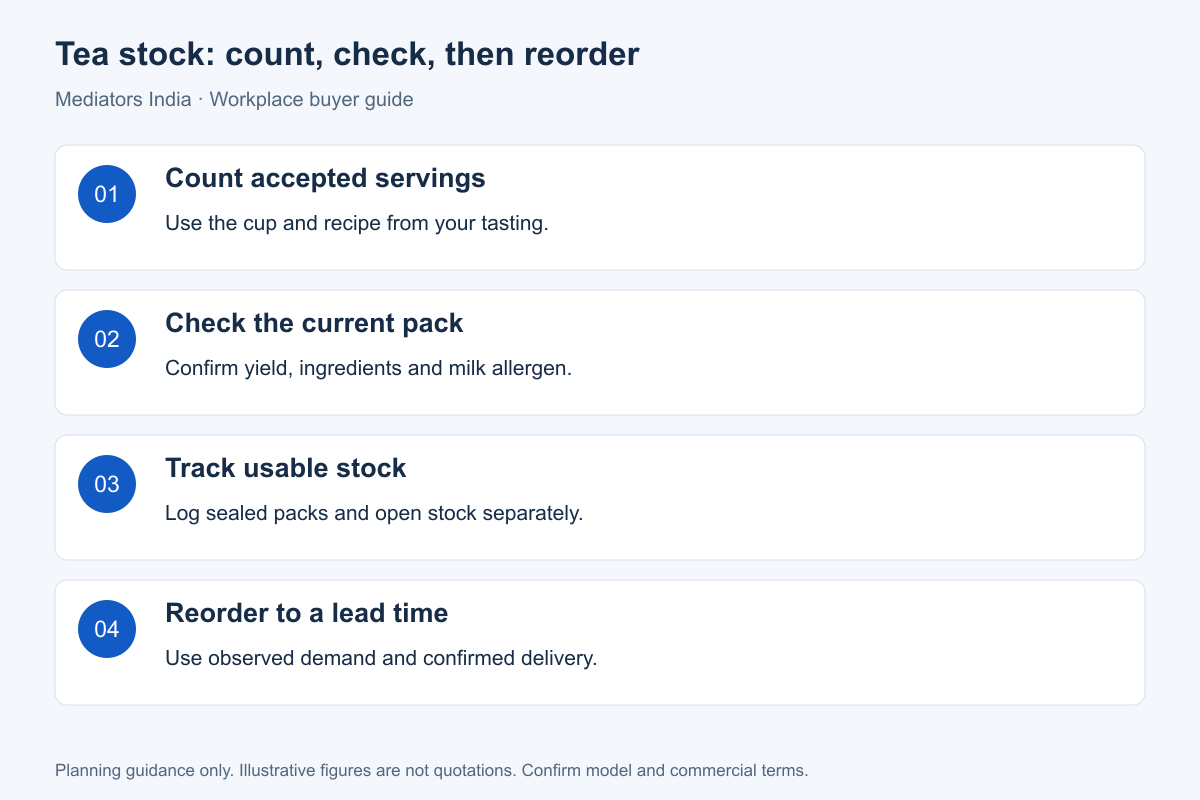
Original planning graphic. Any figures shown are illustrative; confirm commercial and technical details.
Taste it without changing three things at once
Use the cup you plan to offer in the office. Try the proposed recipe as supplied, then record what people actually say about spice, tea flavour and sweetness. Have the operator explain any available adjustment rather than adding ingredients yourself.
Someone who likes a strong masala flavour may have a different view from someone who normally drinks plain tea. Record both. A short tasting can reveal whether this should be your main tea option or one choice alongside another.
A stock worksheet you can replace with real numbers
The example below assumes 20 tea servings per working day and 22 working days. That is 440 monthly servings. It uses the website's 71-cup figure only as a provisional planning input, pending the preparation check above.
| Step | Illustrative calculation | Result |
|---|---|---|
| Monthly tea servings | 20 × 22 | 440 |
| Packs at 71 servings per pack | 440 ÷ 71 | About 6.20 packs |
| Whole packs needed from zero stock | Round 6.20 upward | 7 packs |
| Theoretical balance | 7 × 71 − 440 | 57 servings |
Seven packs is arithmetic, not a recommended monthly order. Existing usable stock, accepted recipe yield, delivery timing and wastage change what you should buy. Order pack sizes and case quantities also need confirmation.
If the actual pack price excluding GST is P, the provisional ingredient cost per serving is P ÷ 71. The illustrative seven-pack cash outlay is 7 × P, before GST. This is not a quotation. It excludes equipment or rental, delivery, cups, water, electricity, cleaning, staff time and any contractual minimum purchase.
Reorder using the pantry's own evidence
For the first few weeks, record packs opened and servings made. Note tastings, spillages or discarded drinks so the stock count makes sense. Do not force an unexplained difference to disappear by changing the expected yield.
A useful reorder trigger is expected use during the supplier's confirmed lead time plus a modest buffer you choose. For example, at an assumed 20 servings a day, three working days of lead time and a two-day buffer require 100 servings of usable stock. These are planning assumptions, not a delivery promise.
Check the label again when stock arrives
Match the product, pack condition, batch and printed date before putting it away. Follow the pack's storage and after-opening instructions. Do not rely on a generic online shelf-life figure to decide how long an already opened pack can remain in use.
Keep milk allergen information available to the people offering drinks. This article does not establish that another recipe or shared machine is suitable for someone avoiding milk; that requires the actual ingredients and preparation arrangements to be checked.
Make the next order a smaller decision
Once you know the accepted recipe and actual usage, repeat the same short calculation. Tea purchasing becomes a stock decision rather than a guess based on headcount.
Browse tea and dairy premix options or request current pack details and a tasting. Include your cup size and expected daily tea count.
Frequently asked questions
Is Masala Gold the same as plain tea powder?
The current manufacturer page describes a tea premix with other ingredients, including sugar and milk solids. Read the current pack rather than treating it as plain tea leaves or unsweetened tea.
How many cups will my office get from a pack?
Use a supplier-confirmed recipe and measured serving size. The public yield is a starting point; resolve the webpage preparation discrepancy before using it for an order.
Does it contain milk?
The manufacturer currently lists milk as an allergen. Check the delivered label and the complete machine preparation arrangement.
Should we buy a full month of stock immediately?
Base the first order on your tasting, current stock and confirmed delivery lead time. A month of stock is not automatically the right starting quantity.
Can we use the six-month website shelf life after opening?
No. An unopened shelf-life statement does not establish an after-opening limit. Use the current pack instructions and obtain clarification where needed.