Monday's snack shelf is full. By Thursday one product has disappeared and another has barely moved. Ordering more of everything repeats the same problem.
A Farmley pantry budget works better when each product has its own row. Count what is taken, record what is left and make the next order from those numbers.
Separate products before counting
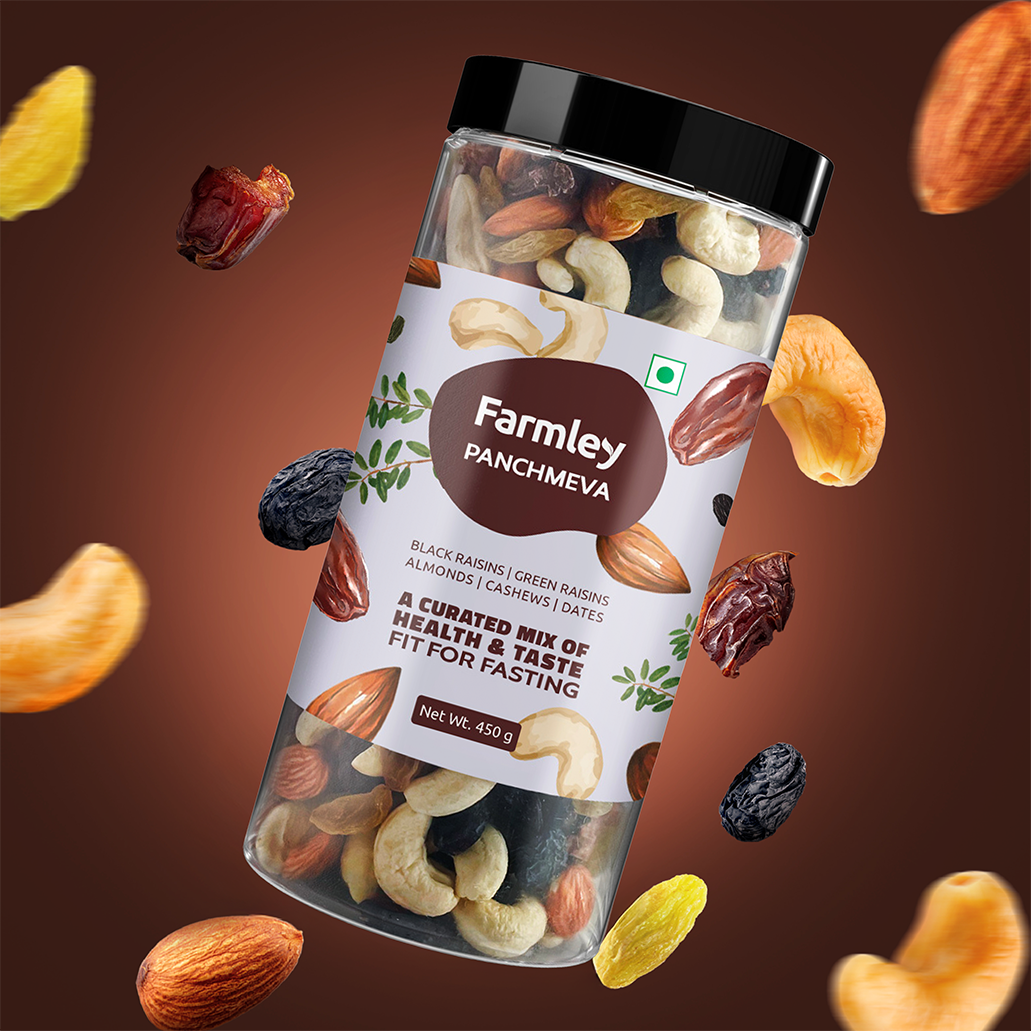
Makhana, a dry-fruit mix and Date Bites are different stock items. A “pack” can mean very different quantities. Record the exact offered product, weight or piece count, and the sale unit used in the quotation.
Use the current Farmley range to identify products, then confirm what can be supplied to your office. Do not borrow a consumer promotion or a pictured assortment as the basis of a workplace supply promise.
Forecast a normal and a quiet week
The following illustrative example dated 22 October 2026 assumes one sealed snack unit per person who accepts the offer. The unit is a planning placeholder, not a named Farmley SKU or a recommended daily intake.
| Input | Quiet week | Normal week |
|---|---|---|
| People present per day | 20 | 30 |
| Assumed acceptance | 50% | 60% |
| Units taken daily | 10 | 18 |
| Five working days | 50 units | 90 units |
| Assumed product cost per unit, excluding GST | ₹25 | ₹25 |
| Product-only budget | ₹1,250 | ₹2,250 |
Every price and acceptance rate here is invented. The example excludes GST, delivery, storage equipment, serving materials, staff time, wastage and any supplier minimum. Substitute the actual quotation and your observed take-up.
Turn the forecast into an order
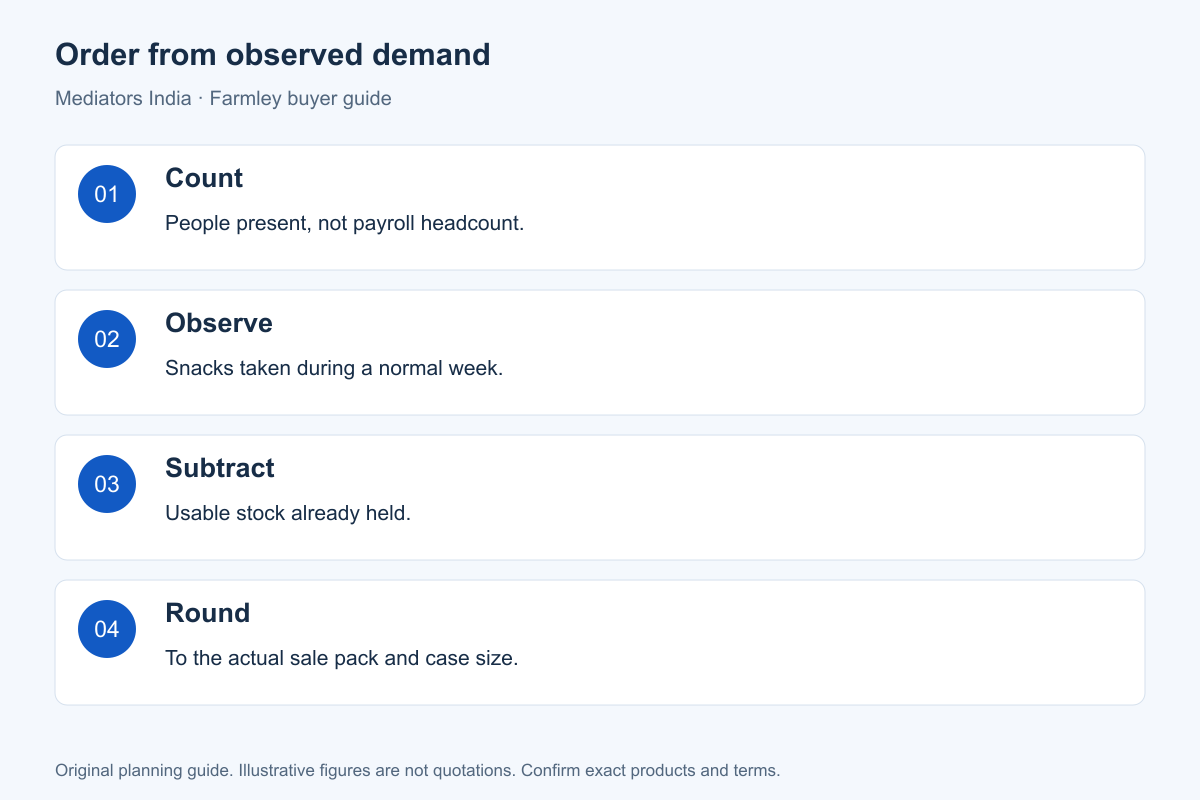
If a normal week needs ninety units and twelve usable units are already on hand, the net requirement is seventy-eight before any chosen reserve. If the actual sale pack contains ten units, eight sale packs give eighty units and a two-unit rounding balance.
That ten-unit sale pack is hypothetical. Use the real case or multipack configuration instead. Keep reserve stock explicit, and check whether the quantity can be stored and used within current label instructions.
Give each SKU its own stock row
Write opening stock, receipts, closing usable stock and any explained losses. The difference is stock issued or otherwise accounted for. It is not automatically the number of people who ate the product.
Record samples, meeting allocations and damaged packs separately. This prevents a one-off event from making the everyday pantry forecast look too low. Keep product dates and opened stock visible rather than treating all remaining stock as equally usable.
Review the assortment, not only the spend
A cheaper item that stays on the shelf is not necessarily the better pantry choice. Compare acceptance and stock movement with price. Where people want a different mix, adjust the next order instead of adding more varieties without a plan.
Avoid treating the acceptance rate as permanent. Attendance, meetings and the novelty of a new snack can all affect a small trial. Use more than one ordinary week before committing to a large recurring quantity.
Ask for a repeatable quotation
Request exact products, units per sale pack, case quantities, GST and delivery terms. Confirm how substitutions are handled. A budget is easier to maintain when the supplier and the pantry are counting the same unit.
Browse Farmley mixes and the snack range, then send your weekly requirement. Include quiet-week demand as well as your normal estimate.
Frequently asked questions
Is ₹25 an actual Farmley price?
No. It is invented for the worksheet. Use an exact product quotation before making a budget.
Should every employee count as one snack daily?
Not automatically. Count attendance and observed acceptance, then revise the estimate.
Can we combine all snack packs in one stock row?
Keep each SKU separate so weights, piece counts and prices remain meaningful.
Does the worksheet include GST and delivery?
No. They are excluded from the example and should be added using the actual quote.
How do we account for a meeting order?
Record it separately from normal pantry issues so it does not distort the everyday forecast.