The total order is correct. The wrong office has most of it.
That is a distribution problem, not a product problem. If one person buys Farmley snacks for two offices, split the order into destinations before approving the total. A combined invoice does not tell a driver how the stock is meant to be handed over.

Give every location its own line
For each office, record the exact product, retail-pack count, address, receiving contact and acceptable delivery window. Keep the product reference identical across locations only if that is what both offices have approved.
A Date Bites jar and a Date Bites gift assortment should not be abbreviated to the same “Farmley box” line. Use the official Original Date Bites reference only for that named product, and ask for the current offered pack to be confirmed.
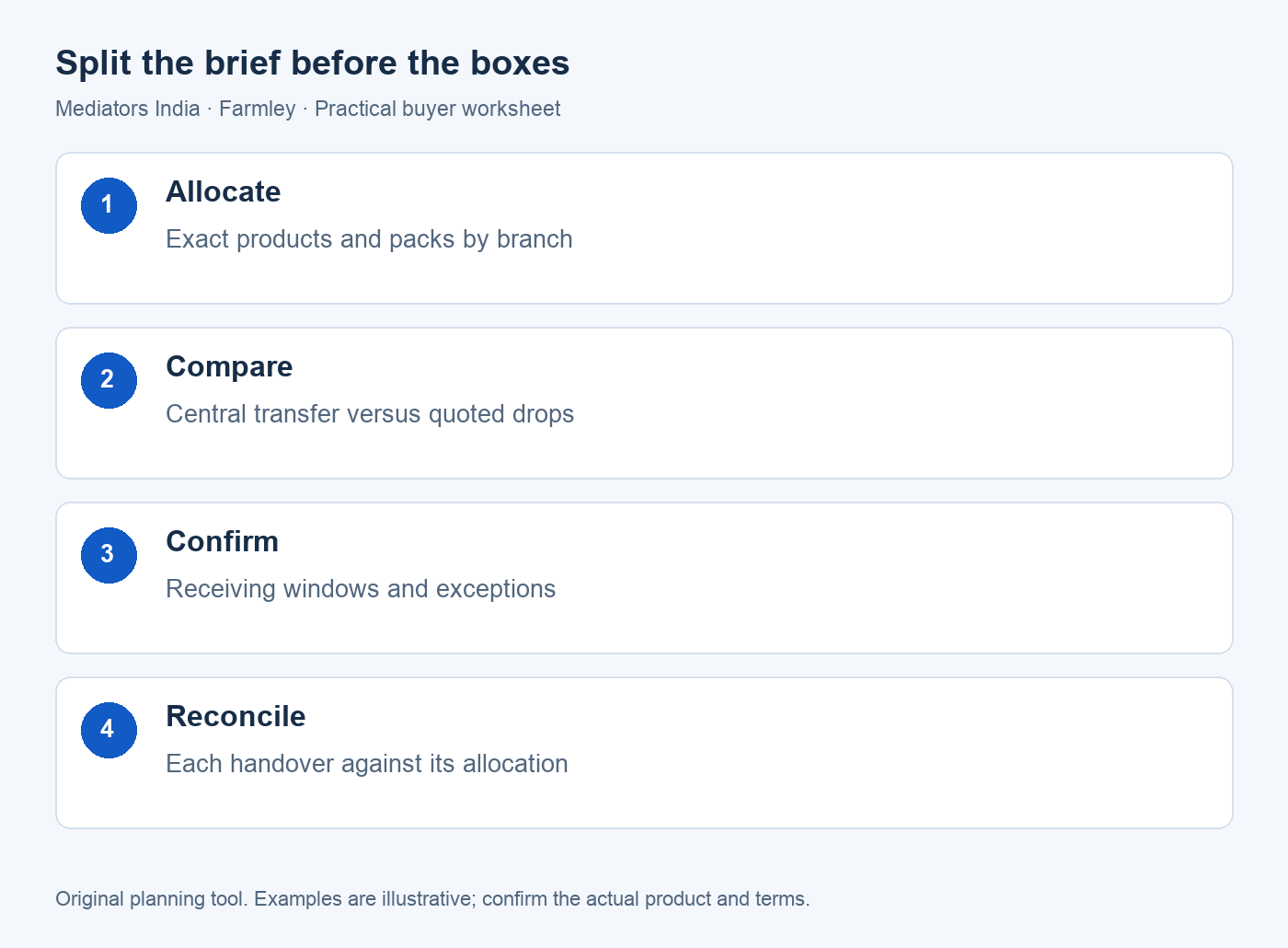
Compare two delivery arrangements
One delivery to a central office may suit a team that already has a suitable internal transfer process. Separate branch drops may be easier where each location manages its own pantry. Ask what the supplier can actually quote; neither arrangement is promised here.
| Arrangement | Costs and responsibilities to ask about |
|---|---|
| Central delivery | Supplier delivery charge, internal handling and branch transfer |
| Separate drops | Charge per destination, minimum order rules and receiving windows |
| Phased deliveries | Each dispatch, agreed dates and any stock reservation terms |
Do not call a consolidated order cheaper until the transfer cost and work are included. A saving on the supplier’s delivery line can disappear on the trip between your own offices.
Use a transparent comparison
Illustrative INR example prepared 27 October 2026, excluding GST: assume the same goods subtotal of ₹6,000 under both options. Central delivery costs ₹150 and the internal transfer costs ₹300, giving ₹6,450. Two separately quoted drops at ₹200 each give ₹6,400.
The ₹50 difference is arithmetic under invented planning inputs, not a supplier quote or a forecast saving. The example excludes staff time, storage, damage, extra trips and any other unquoted charges. Ask for applicable GST treatment on the actual goods and services; do not assume one tax rate covers every line.
Confirm what happens if one office cannot receive
Name the person who can approve a changed delivery window. Agree whether the other branch still receives its allocation and what happens to the missed portion. Do not assume the supplier will hold stock, make a free second trip or accept a changed address without confirmation.
Give each office its own receiving sheet. In an illustrative allocation of 12 packs to one office and eight to another, the central total is 20, but the two signatures should still reconcile to 12 and eight.
Send a brief people can act on
Attach the destination allocation to your Mediators India enquiry. Ask for product identity, quantity, delivery charges, GST basis and dispatch arrangements to be confirmed together. This is how a multi-office quote becomes comparable without pretending that local coverage or a particular delivery service is already agreed.
Frequently asked questions
Can one Farmley order be split between offices?
Ask whether the supplier can quote the requested destinations and quantities. This guide does not promise a split-delivery service.
Is a central delivery always cheaper?
Compare the supplier charge plus your internal transfer and handling. The example uses illustrative inputs, not actual delivery rates.
Are the example figures inclusive of GST?
No. They exclude GST and the listed operational exclusions. Confirm tax treatment in the actual quotation.
Should branch contacts appear in the public blog?
No. Share real receiving contacts privately with the supplier as needed for the order.
What if one branch changes its quantity?
Revise the branch allocation and obtain a confirmed total before dispatch, including any change to charges.