Choosing an office coffee machine in Chandigarh means checking how it will work for your team. A model can look right in a brochure but leave people queuing, the tea too sweet or the cleaning routine unclear. Compare the actual drinks, demand and operator tasks before choosing.
Jump to frequently asked questions ↓
Start with the working day: who is in the office, what they drink and when they want it. Then check the pantry space and local supply and service arrangements. Here is how to build a shortlist for a workplace in Chandigarh, Mohali or Panchkula.
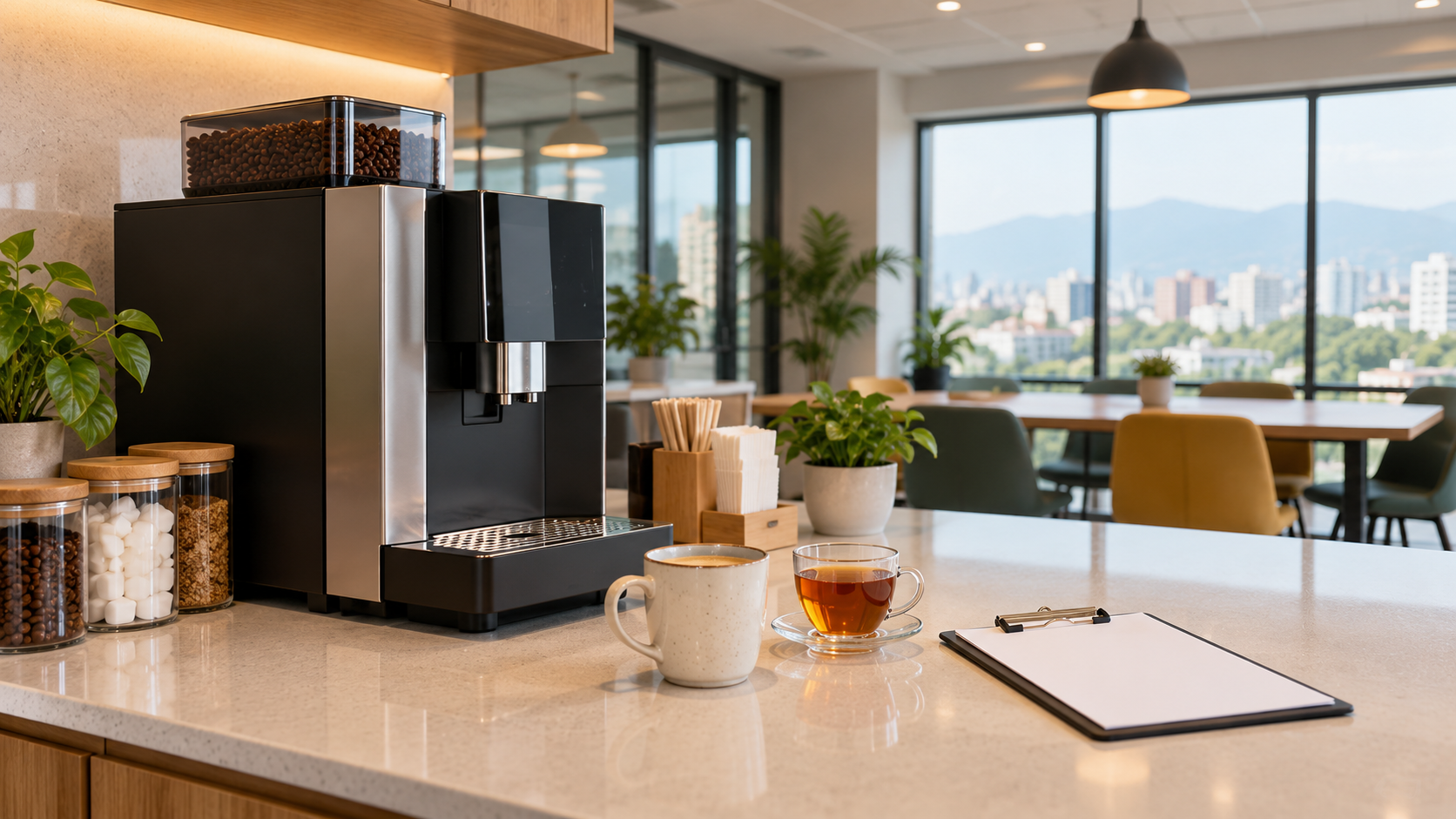
AI-generated illustrative scene; not a real customer installation or an exact product model.
Office coffee machine in Chandigarh: estimate daily drinks
Headcount is a starting point. Count people who are usually on site, estimate drinks per person and add visitor demand. If you already serve beverages, record actual cups for a typical working week before asking for recommendations. Include quieter days as well as busy ones.
For example, suppose 40 people attend the office on a typical day and each takes an average of 1.5 machine-made drinks. Add 10 visitor drinks and the estimate becomes 70 drinks per day. Over 22 working days, that is 1,540 drinks per month. These are illustrative planning assumptions, not a recommended consumption level or a machine capacity rating.
Daily demand is only half the picture. If 20 of those drinks are requested during a 15-minute break, the setup needs to serve that burst as well as the rest of the day. Ask the supplier to demonstrate the intended drink mix and cup size at your expected peak. Include refill, water and cleaning interruptions in the discussion; a headline output figure alone may not describe your workflow.
2. Agree on the drinks people will use
Run a short preference check: tea, black coffee, milk-based coffee or hot chocolate? Are chilled drinks essential, occasional or unnecessary? You do not need every possible option to build a useful pantry.
Ask for a tasting with the proposed ingredients and serving size. Product dosage and drink settings affect both the experience and the running cost, so compare the configuration you would actually use. Confirm which menu options are available on the proposed model rather than assuming every machine offers the same drinks.
3. Compare the equipment approaches
Use this table to shape your questions. Exact capabilities depend on the model, ingredients and configuration.
| Approach | A reason to consider it | What to check before choosing |
|---|---|---|
| Premix beverage machine | A shortlist for a straightforward tea-and-coffee menu | Available premixes, serving yield, storage, cleaning and cup consistency |
| Instant-soluble beverage machine | A shortlist when you want several configured beverage choices | Actual menu, ingredient system, dosing and replenishment routine |
| Bean-to-cup coffee machine | A shortlist when brewing coffee from beans is a priority | Available recipes, milk arrangement, cleaning tasks and peak service performance |
| Hot-and-cold or dedicated cold equipment | A shortlist when chilled drinks are a real workplace requirement | Temperature/menu capabilities, utilities, cleaning and counter space |
Mediators India's current machine and beverage range lists different equipment categories. Use it to begin a conversation, then request the specific model's current specification sheet and available configuration. Availability and supply terms need confirmation.
Shortlist an actual preparation system
Start with the drink preference, then shortlist a system. Spectra Triple Option is a premix-based option; Amigo is a bean-to-cup option. The category is not a taste score or a promise that every selection uses the same ingredients. Confirm the complete proposed configuration and test its drinks.
| What your office values | What to test | What would rule a proposal out |
|---|---|---|
| Less-sweet drinks | Ingredient label and the actual unsweetened recipe | Sugar built into the only acceptable menu option |
| Coffee brewed from beans | The offered bean-to-cup configuration and coffee | A demonstration of an unrelated soluble recipe |
| Short queues | Your cup size and drink mix during the busy break | Acceptable output only at a different serving size |
| Low daily use | Quiet-month bill and ingredient turnover | A minimum commitment far above realistic use |
| Simple operation | Operator's refill and closing routine | Tasks nobody on site can reliably cover |
A tasting protocol your team can use
Select a few colleagues with different drink preferences. Taste the actual menu in the intended cups, first without discussing brand or price. Record acceptance, sweetness and strength on a simple 1–5 scale of your own choosing. This is a proposed internal decision aid, not a validated sensory test.
Public office/clinic buyer discussion on Reddit highlights the tension between taste, convenience and low consumption. That is useful for forming questions, but it does not prove any recommended model or general satisfaction rate.
Ask the supplier to record the recipe people accepted and repeat it after several consecutive servings. Time the actual busiest drink mix, including people selecting drinks and any necessary replenishment. Then review the installed result: BUNN's commercial water guidance explains why water suitable for drinking is not automatically ideal for beverage preparation or equipment. Confirm the selected machine's requirements rather than prescribing a universal water treatment.
Accept a shortlist only when taste, demand, site and full commercial terms fit together. A bigger advertised menu does not resolve a mismatch in any one of those areas.
4. Check the pantry before you shortlist
Measure the usable counter area and the space above and around the equipment. Ask for the manufacturer's required clearances, electrical requirements and water arrangement for each candidate. Check access for filling, emptying, cleaning and servicing, not just the machine's footprint.
Give the supplier photographs and measurements of the proposed position. Confirm whether any plumbing, filtration, drainage or electrical work is required, who arranges it and what it costs. Do not assume two visually similar machines have the same installation requirements.
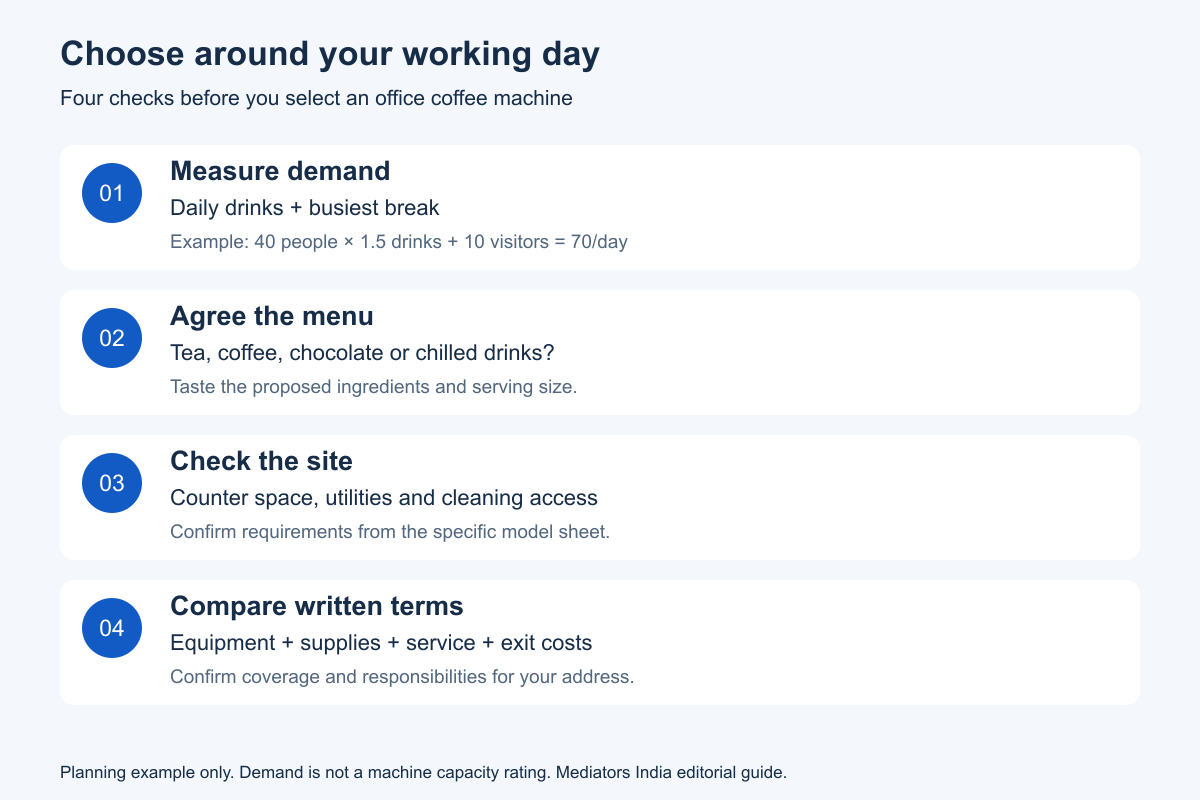
Begin with demand and drinks; confirm the site and written terms before deciding.
5. Budget for the setup and its running costs
Use the Tea Coffee Cost Calculator to compare your current seller or staff-prepared drinks with a complete-premix machine budget. The fixed yields are planning assumptions; bean-to-cup and separate-ingredient machines need model-specific recipe costs.
Separate the equipment arrangement from beverage consumption. Request an itemised quote for rental or purchase, installation, any deposit, ingredients, service and other charges. Check minimum purchases, tenure and what happens if demand falls. This article focuses on equipment selection; compare the rental and purchase proposals once you have a suitable shortlist.
Here is a simple ingredient-budget worksheet using the 70-drink example. The ₹6 and ₹8 figures are illustrative assumptions dated 22 October 2026, not market prices or Mediators India quotations.
| Planning input | Example A | Example B |
|---|---|---|
| Drinks per month | 1,540 | 1,540 |
| Assumed ingredient cost per drink | ₹6 | ₹8 |
| Monthly ingredient budget | ₹9,240 | ₹12,320 |
The ₹2 difference adds ₹3,080 per month at this volume. Compare ingredients at equivalent serving sizes and drink quality; do not assume the two examples describe equivalent products. These figures cover ingredients only and exclude GST, machine rental or purchase, deposits, delivery, installation, service, utilities, cups, cleaning supplies, wastage and staff time. A contractual minimum purchase may also change the actual bill.
For a usable quotation, ask for pack prices, dosage and expected servings per pack for your chosen menu. Replace these assumptions with confirmed figures before setting a final budget.
6. Make service responsibilities explicit
For a local office, ask who handles routine cleaning, replenishment, preventive maintenance and breakdowns. Request the service coverage for your exact address in Chandigarh, Mohali or Panchkula. Do not treat a general service-area statement as a promised response time.
Check whether visits, parts, replacement equipment or operator training are included. If a response time is important to your business, ask for the commitment in writing. Assign someone in the office to the tasks that remain your responsibility.
7. Send a clear brief and request a demonstration
You can get a more useful recommendation by sharing this brief:
1. Exact office location and usual daily attendance.
2. Estimated daily drinks and busiest 15-minute period.
3. Preferred menu and serving size.
4. Pantry measurements, photographs and known utility arrangements.
5. Equipment budget, intended usage period and rental/purchase preference.
6. Cleaning, refill and service expectations.
Ask the supplier to explain why each proposed model fits that brief. A demonstration should answer practical questions about drink quality, preparation, refilling and cleaning—not simply show the machine switching on.
Frequently asked questions
Which coffee machine is best for a 20-person office?
Attendance is not enough to choose. Estimate daily drinks, peak demand, preferred recipes and quiet-month spending. A smaller office that hosts visitors can need a different arrangement from one with infrequent pantry use.
Is an instant-soluble machine the same as bean-to-cup?
No. They use different preparation systems. If your team specifically wants coffee brewed from beans, ask to taste that system rather than assuming every commercial coffee machine provides it.
Can we have coffee without sugar?
Possibly, depending on the menu and ingredients. Check whether sugar is in the blend itself and taste the proposed unsweetened recipe; a separate sugar setting alone does not answer the question.
How many cups per minute do we need?
Divide your expected peak drinks by the time available, then test the exact menu. For example, 20 drinks in 15 minutes needs an average of 1.33 drinks per minute before allowing for interruptions; it does not establish which model will meet it.
Can I use cheaper coffee powder in any machine?
Do not assume interchangeability. Soluble powder, approved premix and ground coffee have different properties. Use compatible supplies and obtain approval before changing products or settings.
Will bean-to-cup remove the need for cleaning?
No. Watch the proposed model's operating and closing routines, including any milk equipment. Assign trained staff; an automated feature does not prove the whole routine is automatic.
Can we compare rental and purchase for every NESCAFÉ model?
Do not presume a purchase option. Nestlé Professional India's current range FAQ describes NESCAFÉ rental models. Compare actual available arrangements, and use our rental-versus-purchase article only for its clearly labelled generic ownership example.
Find a setup that fits your workplace
The best starting point is a measured brief: expected cups, the drinks your team wants and the pantry you have. Once those are clear, compare suitable equipment and written commercial terms.
Explore office coffee machine options in Chandigarh, Mohali and Panchkula and share your requirements with Mediators India. Specific equipment, configurations, availability and prices will be confirmed in your proposal.