Compare Alan’s chips pack sizes using net weight and the number of packets in the quote. A bigger-looking packet is not a measurement, and an old price label may not describe the current offer. Put the exact quantities beside the amount before deciding.
The right format also needs to fit the way you sell or serve it. A pack that looks efficient on a calculator can be awkward on a narrow rack or unsuitable for the amount someone wants to buy.
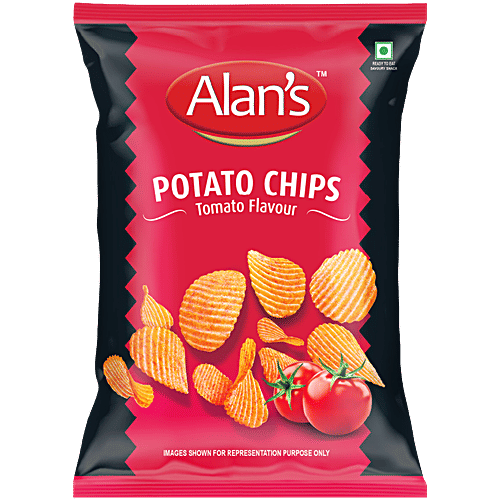
Compare Alan’s chips pack sizes within the same flavour
Where possible, compare the same flavour across the two formats. Changing flavour and size together makes it harder to know what the buyer preferred. Record the complete product name, the current printed net quantity and the pack offered in each quote.
Mediators India’s RCPL range page is a starting point for an enquiry, not a live pack-size catalogue. Ask for the formats currently offered. The photographs here show named products; they do not verify the net weight of every size you might be quoted.
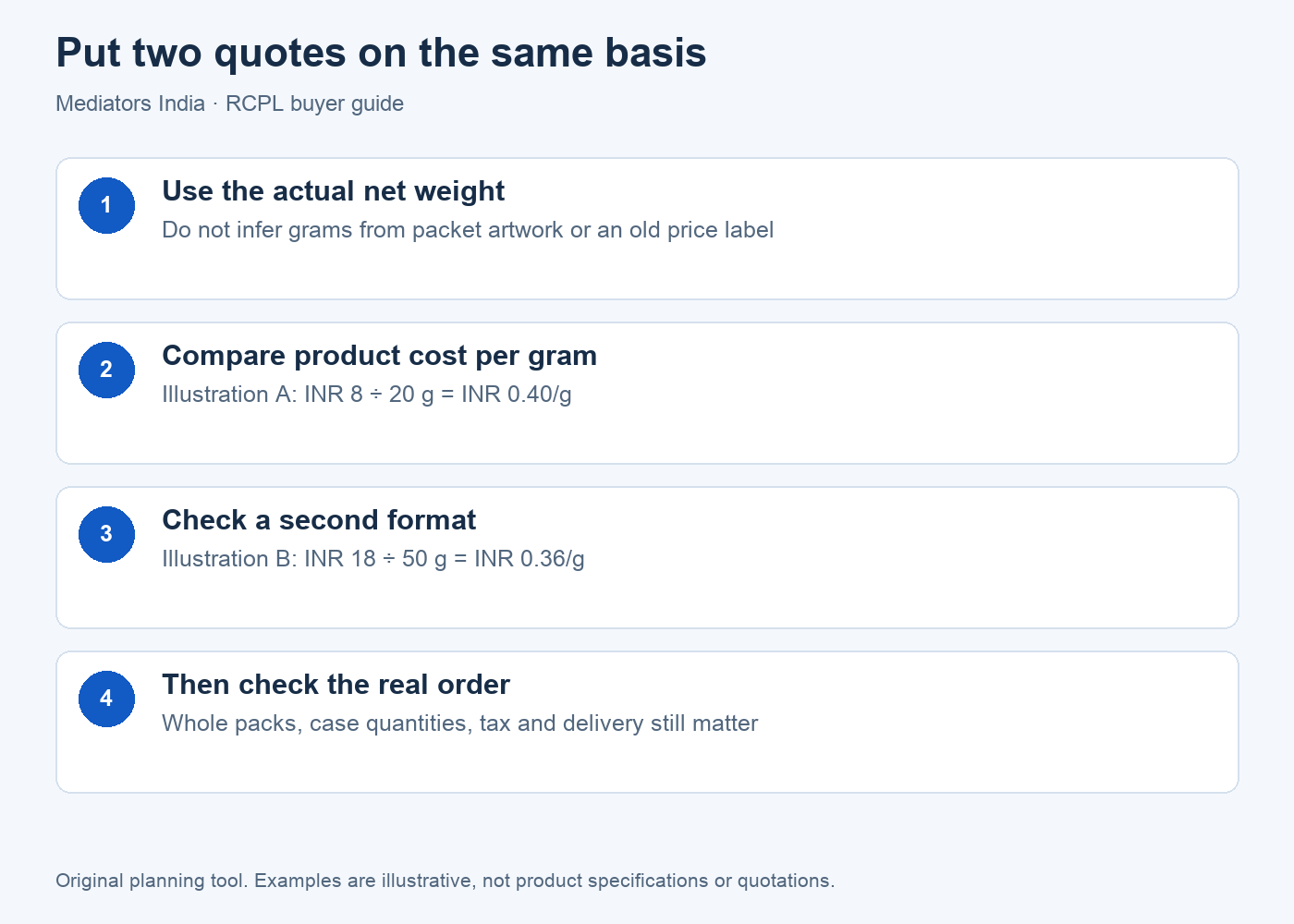
Use cost per gram as one common measure
For this illustration prepared on 24 October 2026, assume Format A contains 20 g and costs ₹8 excluding GST; Format B contains 50 g and costs ₹18 excluding GST. These are invented inputs, not Alan’s pack specifications, MRPs or trade prices.
| Illustrative input | Format A | Format B |
|---|---|---|
| Assumed net quantity | 20 g | 50 g |
| Assumed product price excluding GST | ₹8 | ₹18 |
| Product cost per gram | ₹0.40 | ₹0.36 |
| Product cost for 100 g of labelled quantity | ₹40 | ₹36 |
The calculation compares product quantity on a common basis. It does not establish which pack will sell better, and the 100 g figure is not a serving recommendation. GST, delivery, display equipment, damaged stock, staff time and unsold stock are excluded.
Work out what you actually have to buy
You purchase whole sale units. If one option requires a larger case commitment, the cheaper cost per gram can still tie up more money on the first order. Ask for retail packets per carton, cartons per order and the full amount payable on the same tax and delivery basis.
Keep product cost and cash paid visible as separate lines if comparing before-tax quotes with tax-inclusive figures. Do not subtract a retail MRP from an ex-tax purchase rate and call the difference a verified margin. That mixes price bases and leaves other costs out.
Give shelf space a number
Measure the shelf or hook area available to the product and note how many intact packs it comfortably holds. Keep reserve stock elsewhere if appropriate to the actual pack guidance. A display that makes packets difficult to remove is not improved by squeezing in the whole delivery.
For a trial, note how often the display needs replenishing and whether buyers ask for a smaller or larger format. That gives you an operational reason to change the next order. It is more informative than deciding that the largest packet is always the economical choice.
Set a rule for substitutions
If a supplier offers another size when the requested format is unavailable, repeat the comparison. Confirm the revised net weight, quantity, price and order total before accepting it. Similar packet artwork does not make two sale units equivalent.
When requesting a quote, send the flavour, the two formats you want compared, your order budget and where the products will be sold. Ask for the current pack labels with the response. Then you can choose on real quantities rather than an image or a remembered price.
Frequently asked questions
Are the 20 g and 50 g examples verified Alan’s pack sizes?
No. Those weights and the ₹8/₹18 prices are invented solely to show the calculation. Replace every input with the actual current pack and quotation.
Does a lower cost per gram make a pack the best choice?
It answers one quantity comparison. Demand, selling price, case commitment, display space and replenishment can change the practical decision.
Can I use an old ₹5,₹10 or₹20 ERP item label as the current MRP?
No. Read the current printed pack and confirm the offered sale unit. A historical master name does not establish today’s pack size or MRP.
Should GST be included in the comparison?
Use a consistent basis and show tax treatment clearly. The example is before GST; the amount payable may include applicable tax and delivery. Confirm the actual invoice treatment.
What if the supplied size changes?
Obtain the revised pack information and repeat the whole-pack and cost-per-gram calculations before confirming the substitution.